hero-1024x427

WATT-FLEX® SPLIT-SHEATH CARTRIDGE HEATERS

Engineered for critical industrial processes, Watt-Flex® cartridge heaters deliver higher throughput, consistent part quality, and improved operational efficiency.

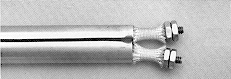
cartridge-end-768x298

Stable Thermal Conditions Drive Manufacturing Performance

When heat transfer is controlled and maintained under operating conditions, manufacturers reduce unplanned downtime, maintain consistent temperature across tooling, and minimize scrap and rework, resulting in more stable production and lower cost per part.

Split-Sheath Design for Controlled Heat Transfer

  • Conductive Heat Transfer Under Load
  • Uniform Thermal Distribution
  • Serviceable Bore Fit

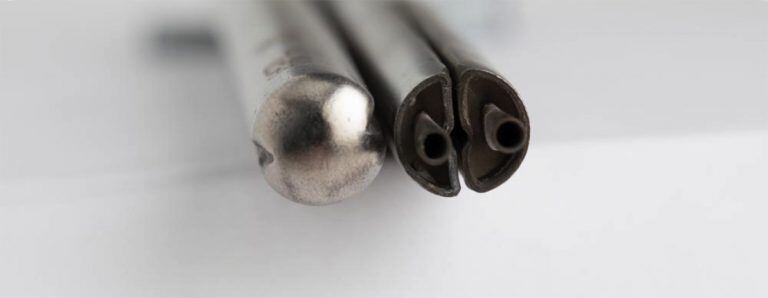
Conventional cartridge heaters rely on fixed diameters that create air gaps between the heater and the bore, limiting conductive heat transfer and introducing thermal variability under operating conditions. Watt-Flex® cartridge heaters address this through a split-sheath design that expands when energized, maintaining metal-to-metal contact with the bore wall and enabling consistent conductive heat transfer. 

By maintaining contact under load, less energy is required to reach and hold temperature, reducing power consumption and stabilizing thermal conditions within the tool. This reduction in thermal variability supports consistent process performance and lowers the operational impact of downtime, scrap, and maintenance. 

Watt-Flex® heaters eliminate ceramic cores and instead use a continuous heating coil embedded in highly compacted magnesium oxide. This construction improves dielectric strength and transfers heat away from the coil more effectively, supporting longer service life under continuous operating conditions.

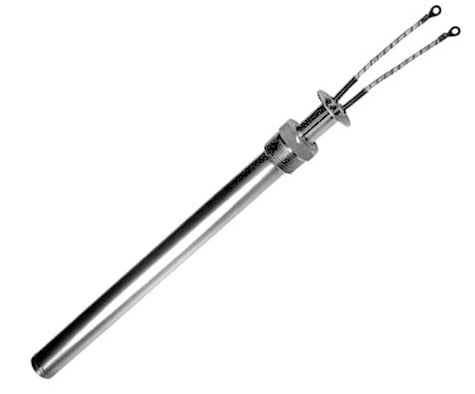
watt-flex-cartridge-home1
1
2
3
1

Hot Tip / Cool Tip Configuration

Watt-Flex® heaters can be configured for localized heating by adjusting coil density within the compacted MgO dielectric, allowing heat to be concentrated or reduced at specific regions along the heater length.

2

Split-Sheath Expansion

The split-sheath expands under operating temperature to maintain contact with the bore and contracts during cool-down for removal. This design accommodates bore variation and eliminates the need for tight-tolerance fits.

3

Continuous Heating Coil

A single continuous heating coil produces consistent heat output along the length of the heater, eliminating sectional failure modes associated with segmented coil designs. 

COMMON FAILURE MODES IN CARTRIDGE HEATER APPLICATIONS

Thermal variability, poor bore contact, and mechanical constraints introduce failure modes that affect process stability, service life, and operating cost.

UNEVEN HEATING

Learn More

SHORT SERVICE LIFE

Learn More

LEAD WIRE FAILURE

Learn More

CONTAMINATION

Learn More

BORE SEIZURE

Learn More

COST OF HEATING

Learn More

THERMAL AND MECHANICAL DESIGN CHARACTERISTICS

 The split-sheath design and manufacturing approach used in Watt-Flex® cartridge heaters maintain consistent bore contact and conductive heat transfer under operating conditions, supporting stable thermal performance and reduced variability in process heating. 

  • Maintaining Conductive Heat Transfer at the Bore Interface
  • Watt Density and Thermal Loading Capability
  • Distributive Wattage and Thermal Profiling
  • Lead Wire Protection and Mechanical Integrity
  • Bore Seizure and Removal Constraints
  • Service Life Under Thermal Load
  • Uniform Temperature Distribution Along the Heater
  • Controlling Thermal Variation Within the Tool
  • Contamination and Environmental Sealing
  • Total Cost of Process Heating

MAINTAINING CONDUCTIVE HEAT TRANSFER AT THE BORE INTERFACE

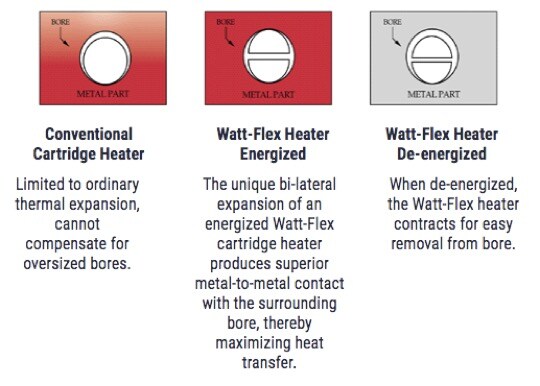
Watt-Flex® cartridge heaters use a split-sheath design that allows each half of the heater to expand outward under operating temperature, maintaining contact with the bore wall. This expansion compensates for dimensional variation and eliminates the air gaps that typically limit conductive heat transfer in conventional cartridge heaters.

Maintaining metal-to-metal contact at the bore interface enables consistent conductive heat transfer along the length of the heater, reducing localized temperature variation within the tool. This results in more uniform thermal conditions and improves the stability of heat-dependent manufacturing processes.

Because conductive heat transfer is maintained under load, less energy is required to achieve and hold temperature, reducing overall power demand. The ability to maintain contact also allows effective operation in oversized or worn bores, where conventional fixed-diameter heaters lose thermal efficiency.
 

heat-transfer

WATT DENSITY AND THERMAL LOADING CAPABILITY

Watt-Flex® cartridge heaters are designed to operate at higher watt densities and temperatures than conventional cartridge heaters, supporting applications with increased thermal loading requirements.

This capability is achieved through material selection and construction. Watt-Flex® heaters use an Incoloy sheath for mechanical strength and corrosion resistance, a nickel-chromium resistance wire for consistent electrical performance, and high-purity magnesium oxide (MgO) as the dielectric medium.

Xray-of-Watt-Flex-cartridge-heater (1)

The MgO is compacted to a high density around the heating coil, eliminating the need for a ceramic core. This compaction improves dielectric strength and increases conductive heat transfer away from the coil, allowing the heater to operate at higher watt densities and temperatures while maintaining stability under load.

By transferring heat more effectively into the surrounding tool, Watt-Flex® supports applications requiring higher thermal input, while reducing localized overheating and extending service life under continuous operating conditions.


DISTRIBUTIVE WATTAGE AND THERMAL PROFILING

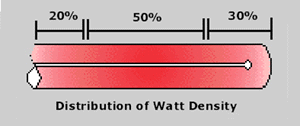
In many applications, heat loss is not uniform along the length of the tool, resulting in temperature variation across the platen or heating surface. Conventional cartridge heaters apply uniform watt density, which does not account for these differences and can lead to localized underheating or overheating.

Watt-Flex® cartridge heaters can be configured with distributed wattage, allowing heat input to be varied along the length of the heater. This enables the thermal profile to be matched to the specific heat loss characteristics of the application.

By adjusting watt density to compensate for edge loss, mass variation, or localized thermal demand, distributed wattage supports uniform temperature distribution across the tool. This improves process stability in applications such as large platens, sealing systems, and heat-sensitive material processing.
cartridge-heater-distributed-wattage-with-zones

LEAD WIRE PROTECTION AND MECHANICAL INTEGRITY

Lead wire failure is a common cause of heater downtime in applications where cables are exposed to movement, abrasion, and chemical environments. Repeated machine cycling and handling can introduce mechanical stress at the termination point, leading to premature failure if not properly protected.

Watt-Flex® cartridge heaters incorporate protected lead configurations using stainless steel headers and conduit options to shield against mechanical and environmental damage. Available protection methods include stainless steel braid for flexibility and tight bend radius, and stainless steel BX conduit for increased strength and abrasion resistance.

Straight and right-angle header configurations allow the lead exit to be aligned with installation constraints, reducing strain at the connection point and improving long-term reliability.

BORE SEIZURE AND REMOVAL CONSTRAINTS

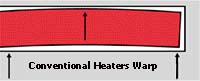
Bore seizure occurs when conventional cartridge heaters warp or bind within the bore during operation. This is typically caused by uneven thermal expansion and temperature differentials along the heater length, leading to bowing and loss of clearance. Once seized, removal can require drilling or tooling damage, resulting in downtime and replacement cost.
 

Conventional-Heaters-Warp-smaller-v2

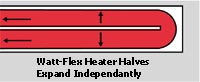
Watt-Flex® cartridge heaters address this through a split-sheath design that allows each half of the heater to expand under operating temperature while maintaining alignment within the bore. During cool-down, the sheath contracts, restoring clearance for removal. This expansion and contraction behavior prevents binding while maintaining consistent contact with the bore for conductive heat transfer.
Watt-Flex-Heater-Expansion

Because contact is maintained through expansion rather than tight installation fit, Watt-Flex® heaters can operate effectively in oversized or worn bores where conventional heaters lose both heat transfer efficiency and serviceability.

Cartridge heater fit is defined as the difference between the bore diameter and the heater sheath diameter. For Watt-Flex®, a slightly oversized bore is recommended to allow insertion and removal, with expansion under load establishing the required contact during operation.


expansion-768x291

SERVICE LIFE UNDER THERMAL LOAD

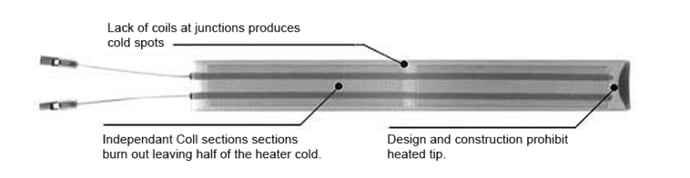
Service life in cartridge heaters is limited by localized overheating, insulation breakdown, and thermal stress at the heating coil. These conditions are often caused by poor contact with the bore and inefficient heat transfer, which allow heat to accumulate within the heater rather than being conducted into the surrounding tool. 
Conventional-heater-XRAY2-768x199
Watt-Flex® cartridge heaters address these failure modes through a combination of high-density magnesium oxide (MgO) compaction and maintained bore contact under operating conditions. The compacted MgO improves dielectric strength and transfers heat away from the coil more effectively, while the split-sheath design expands to maintain contact with the bore, reducing temperature gradients along the heater.

Watt-Flex-XRAY2

By limiting localized overheating and maintaining consistent heat transfer, thermal stress on the coil is reduced, supporting longer service life under continuous-duty operation. 

UNIFORM TEMPERATURE DISTRIBUTION ALONG THE HEATER

Watt-Flex® cartridge heaters use a single continuous heating coil, producing consistent heat output along the length of the sheath and maintaining a uniform temperature distribution within the tool. 
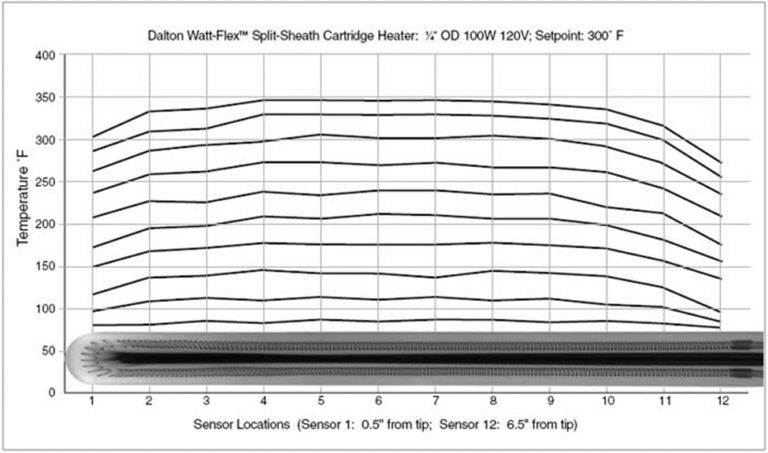
image1-768x453

Conventional cartridge heaters use segmented coils separated by junctions, which create localized temperature variation. These junctions introduce hot and cold regions along the heater length, resulting in uneven thermal conditions within the tool. Competitor-Heat_profile
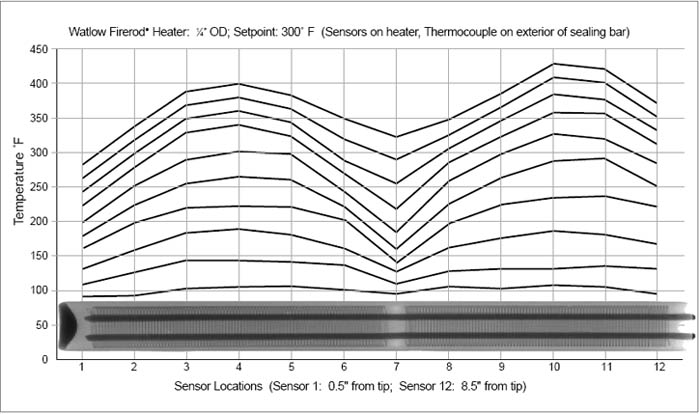
 This difference in heat distribution affects process stability, particularly in applications where temperature uniformity directly influences material behavior and part consistency. 

Controlling Thermal Variation Within the Tool

Uneven heating within tooling introduces temperature variation that affects material behavior, part quality, and process repeatability. In conventional cartridge heaters, segmented coil construction and inconsistent bore contact contribute to non-uniform heat distribution along the heater length.

Watt-Flex® cartridge heaters use a continuous heating coil and maintain bore contact under operating conditions, enabling consistent conductive heat transfer and reducing thermal variation within the tool. This allows temperature to be controlled within a narrower range, particularly in applications where materials are sensitive to temperature fluctuation.

In processes such as molding, sealing, and extrusion, where materials operate within defined thermal windows, maintaining consistent temperature reduces the risk of degradation, scrap, and variability in finished parts.


CONTAMINATION AND ENVIRONMENTAL SEALING

Exposure to water, chemicals, and cleaning processes can compromise heater performance by degrading insulation and introducing electrical failure. This is common in environments involving washdown, oil exposure, or high-pressure cleaning, where contaminants can penetrate the heater termination if not properly sealed.

Watt-Flex® cartridge heaters incorporate sealing and protection methods at the header and lead interface to limit contamination ingress and maintain dielectric integrity under these conditions.

Available protection configurations include:

  • Full weld around header
  • Sealed collar with full weld around header
  • BX-5 convolute protection
  • RTV potting with MW transition and FX wire
  • RTV potting with Teflon or FX wire
  • Fully potted header

These configurations are selected based on environmental exposure and application requirements to ensure reliable operation in contaminated or washdown conditions.


TOTAL COST OF PROCESS HEATING

The cost of process heating extends beyond the heater itself and includes energy consumption, cycle time, downtime, scrap, and maintenance over the life of the equipment. In conventional cartridge heaters, limited bore contact and inefficient heat transfer increase these costs by requiring more energy input, introducing thermal variability, and accelerating wear.

Watt-Flex® cartridge heaters maintain conductive heat transfer under operating conditions by expanding to contact the bore, reducing the energy required to reach and hold temperature. This stabilizes thermal conditions within the tool, supporting repeatable cycle performance and reducing variability that contributes to scrap and rework.

By improving heat transfer and maintaining consistent thermal conditions, Watt-Flex® reduces power consumption, shortens cycle time, and extends service intervals. Across these factors, the total cost of process heating is reduced by an average of 40% compared to conventional cartridge heaters.

 

Maintaining Conductive Heat Transfer at the Bore Interface

MAINTAINING CONDUCTIVE HEAT TRANSFER AT THE BORE INTERFACE

Watt-Flex® cartridge heaters use a split-sheath design that allows each half of the heater to expand outward under operating temperature, maintaining contact with the bore wall. This expansion compensates for dimensional variation and eliminates the air gaps that typically limit conductive heat transfer in conventional cartridge heaters.

Maintaining metal-to-metal contact at the bore interface enables consistent conductive heat transfer along the length of the heater, reducing localized temperature variation within the tool. This results in more uniform thermal conditions and improves the stability of heat-dependent manufacturing processes.

Because conductive heat transfer is maintained under load, less energy is required to achieve and hold temperature, reducing overall power demand. The ability to maintain contact also allows effective operation in oversized or worn bores, where conventional fixed-diameter heaters lose thermal efficiency.


heat-transfer

Watt Density and Thermal Loading Capability

WATT DENSITY AND THERMAL LOADING CAPABILITY

Watt-Flex® cartridge heaters are designed to operate at higher watt densities and temperatures than conventional cartridge heaters, supporting applications with increased thermal loading requirements.

This capability is achieved through material selection and construction. Watt-Flex® heaters use an Incoloy sheath for mechanical strength and corrosion resistance, a nickel-chromium resistance wire for consistent electrical performance, and high-purity magnesium oxide (MgO) as the dielectric medium.

Xray-of-Watt-Flex-cartridge-heater (1)

The MgO is compacted to a high density around the heating coil, eliminating the need for a ceramic core. This compaction improves dielectric strength and increases conductive heat transfer away from the coil, allowing the heater to operate at higher watt densities and temperatures while maintaining stability under load.

By transferring heat more effectively into the surrounding tool, Watt-Flex® supports applications requiring higher thermal input, while reducing localized overheating and extending service life under continuous operating conditions.


Distributive Wattage and Thermal Profiling

DISTRIBUTIVE WATTAGE AND THERMAL PROFILING

In many applications, heat loss is not uniform along the length of the tool, resulting in temperature variation across the platen or heating surface. Conventional cartridge heaters apply uniform watt density, which does not account for these differences and can lead to localized underheating or overheating.

Watt-Flex® cartridge heaters can be configured with distributed wattage, allowing heat input to be varied along the length of the heater. This enables the thermal profile to be matched to the specific heat loss characteristics of the application.

By adjusting watt density to compensate for edge loss, mass variation, or localized thermal demand, distributed wattage supports uniform temperature distribution across the tool. This improves process stability in applications such as large platens, sealing systems, and heat-sensitive material processing.

cartridge-heater-distributed-wattage-with-zones

Lead Wire Protection and Mechanical Integrity

LEAD WIRE PROTECTION AND MECHANICAL INTEGRITY

Lead wire failure is a common cause of heater downtime in applications where cables are exposed to movement, abrasion, and chemical environments. Repeated machine cycling and handling can introduce mechanical stress at the termination point, leading to premature failure if not properly protected.

Watt-Flex® cartridge heaters incorporate protected lead configurations using stainless steel headers and conduit options to shield against mechanical and environmental damage. Available protection methods include stainless steel braid for flexibility and tight bend radius, and stainless steel BX conduit for increased strength and abrasion resistance.

Straight and right-angle header configurations allow the lead exit to be aligned with installation constraints, reducing strain at the connection point and improving long-term reliability.

Bore Seizure and Removal Constraints

BORE SEIZURE AND REMOVAL CONSTRAINTS

Bore seizure occurs when conventional cartridge heaters warp or bind within the bore during operation. This is typically caused by uneven thermal expansion and temperature differentials along the heater length, leading to bowing and loss of clearance. Once seized, removal can require drilling or tooling damage, resulting in downtime and replacement cost.


Conventional-Heaters-Warp-smaller-v2

Watt-Flex® cartridge heaters address this through a split-sheath design that allows each half of the heater to expand under operating temperature while maintaining alignment within the bore. During cool-down, the sheath contracts, restoring clearance for removal. This expansion and contraction behavior prevents binding while maintaining consistent contact with the bore for conductive heat transfer.

Watt-Flex-Heater-Expansion

Because contact is maintained through expansion rather than tight installation fit, Watt-Flex® heaters can operate effectively in oversized or worn bores where conventional heaters lose both heat transfer efficiency and serviceability.

Cartridge heater fit is defined as the difference between the bore diameter and the heater sheath diameter. For Watt-Flex®, a slightly oversized bore is recommended to allow insertion and removal, with expansion under load establishing the required contact during operation.


expansion-768x291

Service Life Under Thermal Load

SERVICE LIFE UNDER THERMAL LOAD

Service life in cartridge heaters is limited by localized overheating, insulation breakdown, and thermal stress at the heating coil. These conditions are often caused by poor contact with the bore and inefficient heat transfer, which allow heat to accumulate within the heater rather than being conducted into the surrounding tool. 

Conventional-heater-XRAY2-768x199
Watt-Flex® cartridge heaters address these failure modes through a combination of high-density magnesium oxide (MgO) compaction and maintained bore contact under operating conditions. The compacted MgO improves dielectric strength and transfers heat away from the coil more effectively, while the split-sheath design expands to maintain contact with the bore, reducing temperature gradients along the heater.

Watt-Flex-XRAY2

By limiting localized overheating and maintaining consistent heat transfer, thermal stress on the coil is reduced, supporting longer service life under continuous-duty operation. 

Uniform Temperature Distribution Along the Heater

UNIFORM TEMPERATURE DISTRIBUTION ALONG THE HEATER

Watt-Flex® cartridge heaters use a single continuous heating coil, producing consistent heat output along the length of the sheath and maintaining a uniform temperature distribution within the tool. 

image1-768x453

Conventional cartridge heaters use segmented coils separated by junctions, which create localized temperature variation. These junctions introduce hot and cold regions along the heater length, resulting in uneven thermal conditions within the tool. Competitor-Heat_profile

 This difference in heat distribution affects process stability, particularly in applications where temperature uniformity directly influences material behavior and part consistency. 

Controlling Thermal Variation Within the Tool

Controlling Thermal Variation Within the Tool

Uneven heating within tooling introduces temperature variation that affects material behavior, part quality, and process repeatability. In conventional cartridge heaters, segmented coil construction and inconsistent bore contact contribute to non-uniform heat distribution along the heater length.

Watt-Flex® cartridge heaters use a continuous heating coil and maintain bore contact under operating conditions, enabling consistent conductive heat transfer and reducing thermal variation within the tool. This allows temperature to be controlled within a narrower range, particularly in applications where materials are sensitive to temperature fluctuation.

In processes such as molding, sealing, and extrusion, where materials operate within defined thermal windows, maintaining consistent temperature reduces the risk of degradation, scrap, and variability in finished parts.


Contamination and Environmental Sealing

CONTAMINATION AND ENVIRONMENTAL SEALING

Exposure to water, chemicals, and cleaning processes can compromise heater performance by degrading insulation and introducing electrical failure. This is common in environments involving washdown, oil exposure, or high-pressure cleaning, where contaminants can penetrate the heater termination if not properly sealed.

Watt-Flex® cartridge heaters incorporate sealing and protection methods at the header and lead interface to limit contamination ingress and maintain dielectric integrity under these conditions.

Available protection configurations include:

  • Full weld around header
  • Sealed collar with full weld around header
  • BX-5 convolute protection
  • RTV potting with MW transition and FX wire
  • RTV potting with Teflon or FX wire
  • Fully potted header

These configurations are selected based on environmental exposure and application requirements to ensure reliable operation in contaminated or washdown conditions.


Total Cost of Process Heating

TOTAL COST OF PROCESS HEATING

The cost of process heating extends beyond the heater itself and includes energy consumption, cycle time, downtime, scrap, and maintenance over the life of the equipment. In conventional cartridge heaters, limited bore contact and inefficient heat transfer increase these costs by requiring more energy input, introducing thermal variability, and accelerating wear.

Watt-Flex® cartridge heaters maintain conductive heat transfer under operating conditions by expanding to contact the bore, reducing the energy required to reach and hold temperature. This stabilizes thermal conditions within the tool, supporting repeatable cycle performance and reducing variability that contributes to scrap and rework.

By improving heat transfer and maintaining consistent thermal conditions, Watt-Flex® reduces power consumption, shortens cycle time, and extends service intervals. Across these factors, the total cost of process heating is reduced by an average of 40% compared to conventional cartridge heaters.


WATT-FLEX® VS. TRADITIONAL CARTRIDGE HEATERS

There’s really no comparison when you pit a traditional cartridge heater against the revolutionary split-sheath design of Dalton’s patented Watt-Flex®…at least in all the categories that matter. See for yourself why we’re the leaders in cartridge heater technology.

Watt-Flex® Cartridge Heater Standard Cartridge Heater
Fast Even Heat | Faster Cycle Time & Less Scrap icon-checked icon-x
Longer Life | Less Downtime & More Throughput icon-checked icon-x
No Bore Seizure | Splitsheath To Prevent Expensive Drillouts icon-checked icon-x
Saves Energy | Reduces The Cost of Heating by 40% icon-checked icon-x
Custom Built | Designed to Fit Your Specific Needs icon-checked icon-x
cartridge-closeup-768x267

CUSTOM MADE SPECIFICALLY FOR YOUR APPLICATION

We have factory-trained sales agents and distributors throughout the world who are ready to assist you with your process heating applications. Please call or send us an email to get started.

TECHNICAL SPECIFICATIONS AND DESIGN DATA

Watt-Flex® cartridge heaters are configured based on application requirements, including geometry, thermal loading, and operating conditions. The following sections provide sizing, configuration options, and design data to support integration into equipment and tooling.

  • Cartridge Heater Sizes
  • Configuration Options and Lead Termination
  • Engineering Data and Design Considerations
  • Immersion Heating and Tank Integration

CARTRIDGE HEADER SIZES

Watt-Flex® cartridge heaters are configured based on application requirements, including bore geometry, thermal loading, and operating conditions. Standard diameter and length ranges are provided below to support initial sizing.

Unlike conventional cartridge heaters, Watt-Flex® heaters do not rely on a tight installation fit. Bore sizing should allow clearance for insertion and removal, with contact established during operation through split-sheath expansion. As a general guideline, the recommended bore diameter is approximately 0.007″ larger than the nominal heater diameter.

For applications requiring dimensions outside the listed ranges or non-standard configurations, Dalton can provide custom sizing based on application constraints.


Available Diameters Nominal Diameters (1) Min. Length (2) Max. Length (2) Standard Cold Section at Terminal End Max. Voltage Max. Watt Density (W/in²)
1/4” 0.245” 1" 12" 5/16” 240 225
3/8” 0.370” 1 1/2" 36" 3/8” 240 200
1/2” 0.495” 2" 50" 5/8” 480 175
5/8” 0.620” 2 1/2" 72" 5/8” 600 150
3/4” 0.745” 3 1/2" 90" 5/8” 600 100
1″ 0.993″ 8" 60" 1” 600 75
8.0 mm 7.875 mm 38 mm 420 mm 8.000 mm 240 200
10.0 mm 9.875 mm 38 mm 700 mm 9.500 mm 240 200
12.0 mm 11.875 mm 50 mm 8000 mm 15.875 mm 480 175
12.5 mm 12.375 mm 50 mm 980 mm 15.875 mm 480 175
16.0 mm 15.875 mm 65 mm 1830 mm 15.875 mm 600 150
20.0 mm 19.875 mm 100 mm 1270 mm 15.875 mm 600 100
25.0 mm 24.875 mm 200 mm 1525 mm 24.400 mm 600 75
             
(1) Tolerances: ±.002″ ( 1/4″ to 3/4″); ±.0025 (1″ ); ±.05mm (8mm-20mm); ±.06mm (25mm)  
(2) Tolerances: ± 3% with 3/32″minimum; ±2% above 20 ” (500 mm)  
For lengths beyond the listed maximum, please contact our Solutioning team.  

CONFIGURATION OPTIONS AND LEAD TERMINATION

 Watt-Flex® cartridge heaters are configured based on application constraints, including electrical requirements, operating temperature, mechanical movement, and serviceability. Lead construction, termination, and protective sleeving are selected to ensure reliable performance within the operating environment. 


Lead Configurations

Lead wire selection is based on operating temperature, electrical requirements, and environmental exposure.

Standard Temperature Leads (TGGT)

Teflon tape primary with glass braid over stranded Grade “A” nickel wire.
Rated for applications up to 480°F (250°C). 

StdLds_186_100

Standard Temperature Teflon Leads

Extruded PFA insulation over stranded Grade “A” nickel wire.
Rated for applications up to 480°F (250°C). 

TeflonLeads_186_100

High Temperature Leads

Fiberglass insulation with treated glass braid over stranded Grade “A” nickel wire.
Rated for applications up to 840°F (450°C). 

HTleads_186_100

Sleeving Options

  • Rubber sleeving for lower temperature applications (<450°F / 230°C)
  • Fiberglass sleeving for higher temperature environments

Termination Options

Termination methods are selected based on serviceability and connection requirements. 

Quick Disconnect

Modular plug or inline junction allowing rapid heater removal and replacement.

QuickDisconn_186x151

Threaded Post Terminal

Mechanical connection point for applications requiring repeated disconnection or integration with busbar systems.
Threaded-Post

Post Terminal
thread dimensions
threaded-post-dimensions-2
Watt-Flex O.D.
Terminal Thread
3/8″ to 3/4″
#6-32
(0.1368″diameter with 32 threads/inch)
1/2 to 1″
#10-24
(0.1894″ diameter with 24 threads/ inch)

ENGINEERING DATA AND DESIGN CONSIDERATIONS

The following data and methods support the evaluation and sizing of cartridge heaters in process heating applications. These calculations and reference values are used to determine required heat input, account for system losses, and establish appropriate watt density under operating conditions.

Heating Metal Parts
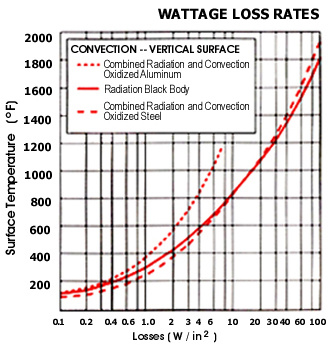
Determining heater capacity requires calculating both the energy required to raise the material temperature and the heat loss that occurs during the heating cycle. Total wattage is the sum of material heat-up and heat loss, with an added safety factor to account for system variability.


loss

Calculation of Required Wattage

  1. WATTS FOR MATERIAL HEAT-UP =
    (Weight of Material (lbs.) x Specific Heat x Temperature Rise (°F)) ÷  (3.412 x Heat up Time (hours))
  2. WATTS HEAT LASS DURING HEAT-UP =
    Watt Loss (per sq. in) x Area (sq.in)
  3. Total Watts Required =
    (A + B) x 1.2
    (20% safety factor)
  4. **Refer to the watt loss chart for applicable loss rates

Physical Properties of Materials Table

Substance Specific Heat Heat of Fusion Lowest 

melting point

Density  Thermal

conductivity

Thermal 

Expansion

  Btu/lboF  Btu/lboF  oF  lb/ft3   lb/in3  Btu/hr/
ft2/oF/ft
 inches per inch 


  per oF x 10-6

Aluminum 1100 .24 169 1190 169 .098 128 13.1
Aluminum 2024 .24 167 935 173 .100 112 12.9
Aluminum 3003 .24 167 1190 170 .099 112 12.9
Antimony .052 69 1166 423 .245 10.9 4.7 – 6.0
Brass .10 1700± 525 .304 56 11.1
Carbon .204  – 6700 .080 13.8 .3 -> 2.4
Copper .10 91 1981 550 .318 224 9.2
Glass .20  – 2200± 165 .096 .45 5
Graphite .20  –   130 .075 .104
Incoloy800 .12  – 2475 501 .290 8.1 7.9
Inconel 600 .11  – 2470 525 .304 9.1 7.4
Invar .13  – 2600 508 .294 6.1 0.6
Iron, Cast .13  – 2300± 450 .260 33 6.5
Iron, wrought .12  – 2800± 480 .278 36 6.5
Lead, solid .031 10 621 710 .411 20 16.3
Lead, melted .04  – 665 .385  –  –
Magnesium .232 160 1202 109 .063 91 14
Monel 400 .11  – 2370 551 .319 14 7.7
Nickel 200 .11 133 2615 554 .321 39 7.4
Nichrome
(80% Ni, 20% Cr)
.11 2550 524 .303 8.7 7.3
 Solder
(50%Pb, 50%Sn)
.04 17 415 580 .336 26 13.1
Steel, mild carbon .12 2550± 490 .284 38 6.7
Steel,stainless 304 .11 2550 488 .282 8.8 9.6
Steel,stainless 430 .11  – 2650 475 .275 12.5 6.0
Tin, solid .056 25 450 455 .263 36 13
Tin, melted .064  – 437 .253 18  –
Type Metal
(85% Pb, 15% Sb)
.040 15 500 670 .388  –
 Zinc .095 51 787 445 .258 65 9.4 – 22

Heating Liquids

When applying cartridge heaters in liquid heating applications, the following conditions must be maintained to ensure safe and effective operation:

  • Heater wells should be located in regions with unrestricted fluid movement
  • The heated section must remain fully submerged during operation
  • In metal melting applications, pressure must be vented during phase change to prevent failure
  • Watt density limits apply in immersion conditions and must be evaluated based on fluid properties


IMMERSION HEATING AND TANK INTEGRATION

Heating liquids in immersion applications introduces both thermal and safety constraints, particularly in environments involving corrosive fluids, phase change, or pressurized conditions. Direct-contact heaters can be difficult to service and may require draining the tank, increasing downtime and operational risk. 


Watt-Flex-Immersion-Heater-background-v3

Dalton’s Watt-Flex® immersion system separates the heating element from the process fluid by using a sealed immersion well. The well consists of a stainless steel sheath with a welded end cap and NPT fitting that integrates into the tank wall and remains in place during operation. The cartridge heater is inserted into this well and secured externally, allowing removal and replacement without exposing the heater to the process fluid.

Because the heater operates within a sealed well, it is protected from chemical exposure and contamination, while maintaining conductive heat transfer through the sheath. The heater can be removed after de-energization, with contraction allowing clearance for extraction without draining the tank. 


Immersion-Heater-NPT-Assembly

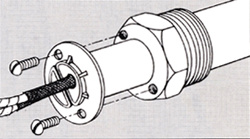
To replace the immersion heater, simply remove the screws, and slide out the de-energized heater.

Immersion Heater Specifications

immersion-d
Immersion wells and cartridge heaters are configured based on application requirements, including tank geometry, fluid characteristics, and thermal loading. Specify overall immersion well length and heater dimensions according to the system design.

Immersion Heater Cartridge Heater
Sheath O.D. NPT Fitting Diameter Length (min-max)
5/8″ 3/4″ 1/2″ 5″ – 45″
7/8″ 1″ 3/4″ 8″ – 72″

Cartridge Heater Sizes

CARTRIDGE HEADER SIZES

Watt-Flex® cartridge heaters are configured based on application requirements, including bore geometry, thermal loading, and operating conditions. Standard diameter and length ranges are provided below to support initial sizing.

Unlike conventional cartridge heaters, Watt-Flex® heaters do not rely on a tight installation fit. Bore sizing should allow clearance for insertion and removal, with contact established during operation through split-sheath expansion. As a general guideline, the recommended bore diameter is approximately 0.007″ larger than the nominal heater diameter.

For applications requiring dimensions outside the listed ranges or non-standard configurations, Dalton can provide custom sizing based on application constraints.


Available Diameters Nominal Diameters (1) Min. Length (2) Max. Length (2) Standard Cold Section at Terminal End Max. Voltage Max. Watt Density (W/in²)
1/4” 0.245” 1" 12" 5/16” 240 225
3/8” 0.370” 1 1/2" 36" 3/8” 240 200
1/2” 0.495” 2" 50" 5/8” 480 175
5/8” 0.620” 2 1/2" 72" 5/8” 600 150
3/4” 0.745” 3 1/2" 90" 5/8” 600 100
1″ 0.993″ 8" 60" 1” 600 75
8.0 mm 7.875 mm 38 mm 420 mm 8.000 mm 240 200
10.0 mm 9.875 mm 38 mm 700 mm 9.500 mm 240 200
12.0 mm 11.875 mm 50 mm 8000 mm 15.875 mm 480 175
12.5 mm 12.375 mm 50 mm 980 mm 15.875 mm 480 175
16.0 mm 15.875 mm 65 mm 1830 mm 15.875 mm 600 150
20.0 mm 19.875 mm 100 mm 1270 mm 15.875 mm 600 100
25.0 mm 24.875 mm 200 mm 1525 mm 24.400 mm 600 75
             
(1) Tolerances: ±.002″ ( 1/4″ to 3/4″); ±.0025 (1″ ); ±.05mm (8mm-20mm); ±.06mm (25mm)  
(2) Tolerances: ± 3% with 3/32″minimum; ±2% above 20 ” (500 mm)  
For lengths beyond the listed maximum, please contact our Solutioning team.  

Configuration Options and Lead Termination

CONFIGURATION OPTIONS AND LEAD TERMINATION

 Watt-Flex® cartridge heaters are configured based on application constraints, including electrical requirements, operating temperature, mechanical movement, and serviceability. Lead construction, termination, and protective sleeving are selected to ensure reliable performance within the operating environment. 


Lead Configurations

Lead wire selection is based on operating temperature, electrical requirements, and environmental exposure.

Standard Temperature Leads (TGGT)

Teflon tape primary with glass braid over stranded Grade “A” nickel wire.
Rated for applications up to 480°F (250°C). 

StdLds_186_100

Standard Temperature Teflon Leads

Extruded PFA insulation over stranded Grade “A” nickel wire.
Rated for applications up to 480°F (250°C). 

TeflonLeads_186_100

High Temperature Leads

Fiberglass insulation with treated glass braid over stranded Grade “A” nickel wire.
Rated for applications up to 840°F (450°C). 

HTleads_186_100

Sleeving Options

  • Rubber sleeving for lower temperature applications (<450°F / 230°C)
  • Fiberglass sleeving for higher temperature environments

Termination Options

Termination methods are selected based on serviceability and connection requirements. 

Quick Disconnect

Modular plug or inline junction allowing rapid heater removal and replacement.

QuickDisconn_186x151

Threaded Post Terminal

Mechanical connection point for applications requiring repeated disconnection or integration with busbar systems.
Threaded-Post

Post Terminal
thread dimensions
threaded-post-dimensions-2
Watt-Flex O.D.
Terminal Thread
3/8″ to 3/4″
#6-32
(0.1368″diameter with 32 threads/inch)
1/2 to 1″
#10-24
(0.1894″ diameter with 24 threads/ inch)

Engineering Data and Design Considerations

ENGINEERING DATA AND DESIGN CONSIDERATIONS

The following data and methods support the evaluation and sizing of cartridge heaters in process heating applications. These calculations and reference values are used to determine required heat input, account for system losses, and establish appropriate watt density under operating conditions.

Heating Metal Parts
Determining heater capacity requires calculating both the energy required to raise the material temperature and the heat loss that occurs during the heating cycle. Total wattage is the sum of material heat-up and heat loss, with an added safety factor to account for system variability.


loss

Calculation of Required Wattage

  1. WATTS FOR MATERIAL HEAT-UP =
    (Weight of Material (lbs.) x Specific Heat x Temperature Rise (°F)) ÷  (3.412 x Heat up Time (hours))
  2. WATTS HEAT LASS DURING HEAT-UP =
    Watt Loss (per sq. in) x Area (sq.in)
  3. Total Watts Required =
    (A + B) x 1.2
    (20% safety factor)
  4. **Refer to the watt loss chart for applicable loss rates

Physical Properties of Materials Table

Substance Specific Heat Heat of Fusion Lowest 

melting point

Density  Thermal

conductivity

Thermal 

Expansion

  Btu/lboF  Btu/lboF  oF  lb/ft3   lb/in3  Btu/hr/
ft2/oF/ft
 inches per inch 


  per oF x 10-6

Aluminum 1100 .24 169 1190 169 .098 128 13.1
Aluminum 2024 .24 167 935 173 .100 112 12.9
Aluminum 3003 .24 167 1190 170 .099 112 12.9
Antimony .052 69 1166 423 .245 10.9 4.7 – 6.0
Brass .10 1700± 525 .304 56 11.1
Carbon .204  – 6700 .080 13.8 .3 -> 2.4
Copper .10 91 1981 550 .318 224 9.2
Glass .20  – 2200± 165 .096 .45 5
Graphite .20  –   130 .075 .104
Incoloy800 .12  – 2475 501 .290 8.1 7.9
Inconel 600 .11  – 2470 525 .304 9.1 7.4
Invar .13  – 2600 508 .294 6.1 0.6
Iron, Cast .13  – 2300± 450 .260 33 6.5
Iron, wrought .12  – 2800± 480 .278 36 6.5
Lead, solid .031 10 621 710 .411 20 16.3
Lead, melted .04  – 665 .385  –  –
Magnesium .232 160 1202 109 .063 91 14
Monel 400 .11  – 2370 551 .319 14 7.7
Nickel 200 .11 133 2615 554 .321 39 7.4
Nichrome
(80% Ni, 20% Cr)
.11 2550 524 .303 8.7 7.3
 Solder
(50%Pb, 50%Sn)
.04 17 415 580 .336 26 13.1
Steel, mild carbon .12 2550± 490 .284 38 6.7
Steel,stainless 304 .11 2550 488 .282 8.8 9.6
Steel,stainless 430 .11  – 2650 475 .275 12.5 6.0
Tin, solid .056 25 450 455 .263 36 13
Tin, melted .064  – 437 .253 18  –
Type Metal
(85% Pb, 15% Sb)
.040 15 500 670 .388  –
 Zinc .095 51 787 445 .258 65 9.4 – 22

Heating Liquids

When applying cartridge heaters in liquid heating applications, the following conditions must be maintained to ensure safe and effective operation:

  • Heater wells should be located in regions with unrestricted fluid movement
  • The heated section must remain fully submerged during operation
  • In metal melting applications, pressure must be vented during phase change to prevent failure
  • Watt density limits apply in immersion conditions and must be evaluated based on fluid properties


Immersion Heating and Tank Integration

IMMERSION HEATING AND TANK INTEGRATION

Heating liquids in immersion applications introduces both thermal and safety constraints, particularly in environments involving corrosive fluids, phase change, or pressurized conditions. Direct-contact heaters can be difficult to service and may require draining the tank, increasing downtime and operational risk. 


Watt-Flex-Immersion-Heater-background-v3

Dalton’s Watt-Flex® immersion system separates the heating element from the process fluid by using a sealed immersion well. The well consists of a stainless steel sheath with a welded end cap and NPT fitting that integrates into the tank wall and remains in place during operation. The cartridge heater is inserted into this well and secured externally, allowing removal and replacement without exposing the heater to the process fluid.

Because the heater operates within a sealed well, it is protected from chemical exposure and contamination, while maintaining conductive heat transfer through the sheath. The heater can be removed after de-energization, with contraction allowing clearance for extraction without draining the tank. 


Immersion-Heater-NPT-Assembly

To replace the immersion heater, simply remove the screws, and slide out the de-energized heater.

Immersion Heater Specifications

immersion-d
Immersion wells and cartridge heaters are configured based on application requirements, including tank geometry, fluid characteristics, and thermal loading. Specify overall immersion well length and heater dimensions according to the system design.

Immersion Heater Cartridge Heater
Sheath O.D. NPT Fitting Diameter Length (min-max)
5/8″ 3/4″ 1/2″ 5″ – 45″
7/8″ 1″ 3/4″ 8″ – 72″

Videos

Learn more about the many benefits of Dalton’s Watt-Flex® Cartridge Heater technology.

Request a quote or Literature

contact

We have factory-trained sales agents and distributors throughout the world who are ready to assist you with your process heating applications. Please call or send us an email to get started.

Dalton Electric Heating Co, Inc.

28 Hayward St, Ipswich, MA 01938

PHONE
978-356-9844

EN ESPAÑeOL
Tenemos hispanohablantes listos para ayudar.
Contacta con nosotros

"*" indicates required fields

Request a quote